
Calories & Habits
Liquid Calories vs. Food Calories: Does Your Body Treat Them Differently?
· 6 min read · By CalDrop
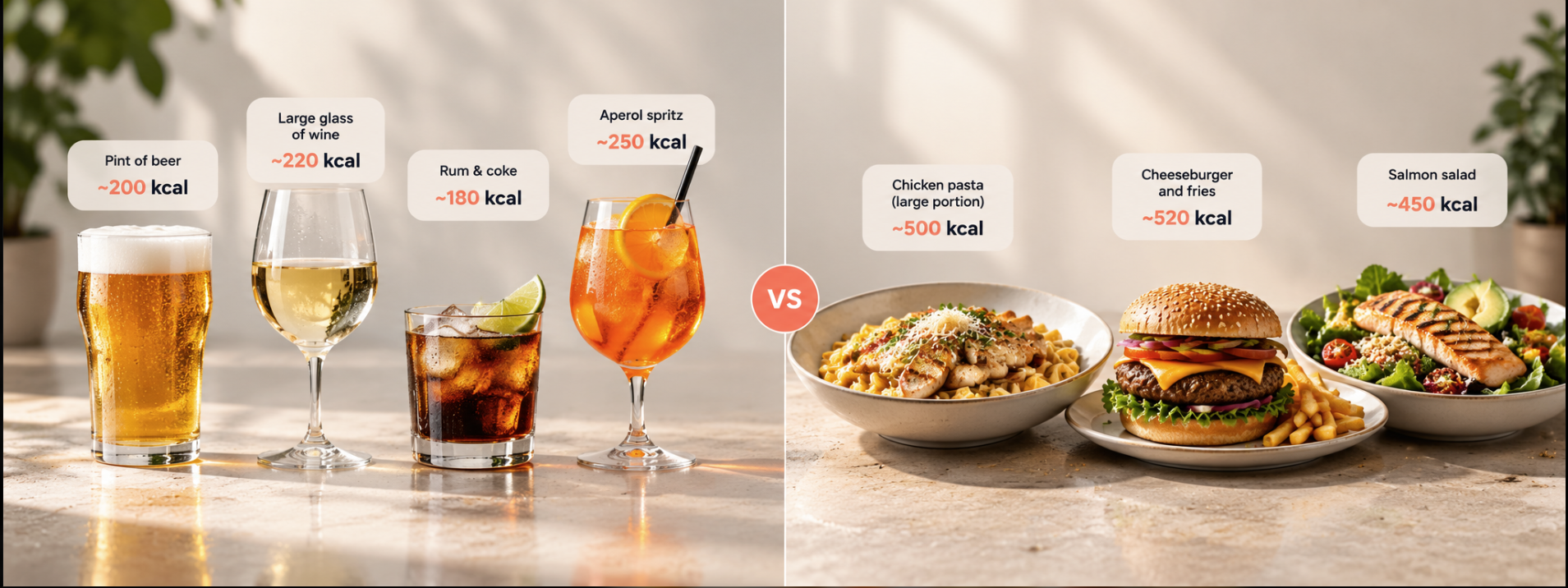
You probably notice a 500-calorie meal. A few drinks can deliver hundreds of calories too, but they may not feel like eating hundreds of calories. So does your body actually respond differently?
The short answer: calories from drinks still count toward your daily energy intake, just like calories from food. But some university studies suggest that calories you drink may be less filling, and people may not eat less later to make up for them. The research is not completely consistent, so food form is best seen as one factor among many.
Is a calorie from a drink the same as a calorie from food?
In terms of energy, yes. A calorie is a unit of energy, and the calories in juice, soda, a latte or a beer contribute to your total intake in the same way that calories from a sandwich do. Your body does not ignore them because they arrive in a glass.
That said, energy is only part of the story. How a food or drink affects hunger, fullness and what you eat afterward can differ, and that is where the form of the calories may matter.
Do drink calories count the same as food?
Yes. Calories from drinks count toward total energy intake just as calories from food do. Equal calorie amounts provide the same amount of energy, but they do not necessarily provide the same nutrients or leave you feeling equally full.
Do alcohol calories count?
Yes. Alcohol itself provides approximately 7 calories per gram, and those calories count toward total energy intake. Sugar, other carbohydrates and mixers can add more calories to an alcoholic drink.
Where liquid calories may be different
Researchers often look at two ideas. Satiety is how full and satisfied you feel after eating or drinking. Dietary compensation is whether you naturally eat less later to balance out extra calories you had earlier.
Some controlled studies have found weaker compensation and satiety responses when calories are consumed as a drink rather than as solid food. In other words, people sometimes drink calories on top of what they would have eaten anyway, rather than in place of it.
What did the Purdue University study find?
One of the best-known studies on this question came from the Department of Foods and Nutrition at Purdue University. Researchers asked 15 adults to add about 450 calories of carbohydrate to their diet every day. For one four-week period, those calories came from soda. For another four-week period, a comparable carbohydrate load came from jelly beans. The two periods were separated by a washout period.
During the jelly bean period, participants tended to eat less of their other food, which partly balanced out the extra calories. During the soda period, they did not show the same compensation. Body weight and BMI increased significantly during the soda period, but not during the jelly bean period.
This was a small study, so it cannot prove that the same thing happens to everyone. It is still useful because it compared liquid and solid calories directly, in the same people, over several weeks.
Why might drinking calories feel different from eating them?
A later randomized crossover study, run by researchers at Purdue University and Indiana University, looked at this in 52 healthy adults. It compared how people responded to the same food presented in liquid and solid forms. Compared with the solid condition, the liquid condition was associated with:
- greater hunger after the meal
- lower feelings of fullness
- faster gastric emptying, meaning the stomach emptied more quickly
- different hormonal responses related to appetite
Total energy intake was also higher on days when participants believed they were having the liquid version than on days when they believed it was solid. That detail is interesting, because it suggests that what people expect from a food or drink may shape how full they feel.
Drinks also usually require no chewing and can be finished quickly, and many people simply do not think of a drink as "eating." These findings come from controlled lab conditions, so they do not mean every beverage will have these effects on every person.
Is the evidence on liquid calories black and white?
No. A review by researchers at the University of Washington looked at the wider body of research and asked how good the evidence really was. It concluded that the evidence that liquids are inherently less satiating than solid foods was not completely consistent. Some studies found weaker satiety from liquids, and others did not.
Many things can influence how full a food or drink makes you feel, including how much protein, fiber or fat it contains, its volume, how quickly you consume it and your own expectations. Whether calories are liquid or solid is one factor among many, not the whole explanation.
What about alcohol calories?
Alcohol provides about 7 calories per gram, more than carbohydrate or protein. Those calories contribute to your overall energy intake, and they do not disappear simply because you drink them. Many alcoholic drinks also contain sugar or other carbohydrates on top of the alcohol itself.
Researchers have also studied whether alcohol affects appetite and how much people eat afterward. A review by Martin Yeomans at the University of Sussex brought together this research. It described controlled studies in which food or total energy intake increased under some alcohol conditions, and it noted that alcohol calories tend not to be balanced out by eating less. Results vary between studies and between people, so this does not mean drinking always makes someone eat more.
The practical point is that alcohol can add calories directly while also making your total intake easier to underestimate. Drinks are often had separately from meals, at the end of a day or on a night out, so they may not feel like part of your daily calories at all.
Are Alcohol Calories the Same as Food Calories?
They count in the same energy total, but their source matters. Alcohol provides approximately 7 calories per gram, compared with about 4 calories per gram from carbohydrate or protein. Alcohol itself supplies energy rather than essential nutrients. As the National Institute on Alcohol Abuse and Alcoholism explains, alcoholic beverages supply calories but few nutrients.
In sugary drinks, sugar is a carbohydrate that supplies energy. In alcoholic drinks, energy can come from both alcohol and carbohydrates, with sweetened mixers adding more. Solid foods can provide protein, fiber, vitamins and minerals, depending on what you eat. Neither "liquid" nor "solid" tells you the whole nutritional story, and not all drinks have the same nutrient content.
Appetite is another difference. A 2019 systematic review and meta-analysis found that, in the short-term studies it examined, participants did not eat less to compensate for alcohol calories. On average, food and total energy intake were higher after alcohol than after non-alcohol comparisons. This does not predict what every person will eat, or establish a long-term weight change. As the liquid-versus-solid research above shows, fullness also depends on the drink or food and the circumstances, not simply whether it comes in a glass.
For serving-specific examples, see our guides to calories in beer, calories in vodka and calories in whiskey. For the evidence on recording those drinks, read what research says about tracking alcohol calories.
The practical takeaway
You don't need to fear liquid calories, and you don't need to cut out drinks or alcohol. You just need to count them. Noticing what you drink, and how it fits alongside what you eat, makes it far easier to see where your calories really come from.
Food counts. Drinks count. Exercise counts. Seeing all three together gives you the bigger picture.
This article is for general information and is not medical or nutritional advice. If you have specific health concerns, talk to a qualified healthcare professional.
Research & Sources
- DiMeglio DP, Mattes RD. Liquid versus solid carbohydrate: effects on food intake and body weight. International Journal of Obesity. 2000;24(6):794–800. Department of Foods and Nutrition, Purdue University. DOI: 10.1038/sj.ijo.0801229
- Cassady BA, Considine RV, Mattes RD. Beverage consumption, appetite, and energy intake: what did you expect? American Journal of Clinical Nutrition. 2012;95(3):587–593. Purdue University and Indiana University. DOI: 10.3945/ajcn.111.025437
- Almiron-Roig E, Chen Y, Drewnowski A. Liquid calories and the failure of satiety: how good is the evidence? Obesity Reviews. 2003;4(4):201–212. University of Washington. DOI: 10.1046/j.1467-789x.2003.00112.x · PubMed abstract
- Yeomans MR. Alcohol, appetite and energy balance: is alcohol intake a risk factor for obesity? Physiology & Behavior. 2010;100(1):82–89. School of Psychology, University of Sussex. DOI: 10.1016/j.physbeh.2010.01.012
- Schutz Y. Role of substrate utilization and thermogenesis on body-weight control with particular reference to alcohol. Proceedings of the Nutrition Society. 2000;59(4):511–517. DOI: 10.1017/S0029665100000744.
- National Institute on Alcohol Abuse and Alcoholism. Alcohol Calorie Calculator. Rethinking Drinking.
- Kwok A, Dordevic AL, Paton G, Page MJ, Truby H. Effect of alcohol consumption on food energy intake: a systematic review and meta-analysis. British Journal of Nutrition. 2019;121(5):481–495. DOI: 10.1017/S0007114518003677.